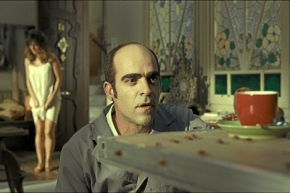
The Man Next Door(El hombre de al lado) is a black comedy about two men and a window. Not just any window. A ghastly window looking into the famous Curutchet House, in Buenos Aires, and the backdrop to this tale of neighbourhood etiquette.
The story begins with a hole in a wall, a hole that sparks a feud of uncommon proportions between neighbours, Leonardo (Rafael Spregelburd) and Victor (Daniel Araoz). Their unique relationship becomes the stage for the film’s complex dealings with human behaviour, as well the basis for laughs. Victor’s master manipulation borders on artform, pushing boundaries and tweaking anxieties in a way audiences are sure to find refreshingly original.
Whilst the pace is at times a little slow, the film’s awkward and unusual humour suffices to drive audience attention through to the last scene without a trace of boredom.
If not a comedy enthusiast, prepare to be captivated by the film’s artistic and architectural beauty. The scenes filmed within the house are a designer’s dream, an exploration into form and colour, engaging the senses with every object on set. Each frame mimics the insides of interior decorating and design magazines. In fact the whole film seems to possess this mood of experimentation with shape, sound and light. From content to cinematography, directors, Mariano Cohn and Gaston Duprat, have ensured that all 103 minutes be a journey into visual and aural space.
Be warned however, despite its seemingly simple plot, the Sundance Award Winner is shaded by a darkness that makes it at times unnerving. Writer, AndresDuprat, has woven an interesting social commentary riddled with disconnection and angst, which perhaps is the film’s true strength.
Guaranteed to inspire thought long after the credits have rolled.
The Chilean entrant for best foreign film at the 83rd Academy Awards, The Life Of Fish (La vida de los peces) is a tender, touching and thoughtful tale of people and possibilities. Garnering significant international acclaim including the 2011 Goya statuette for best Spanish language feature, writer / director Matías Bize’s eighth effort, co-scripted with Julio Rojas, ponders things that could have been, opportunities that fail to eventuate, ideas that linger in the memory, and actions that inevitably have both positive and negative repercussions.
On a brief sojourn to his home town to attend to errands, jet-setting travel writer Andrés (Santiago Cabrera) takes the opportunity to connect with old friends. Attending a birthday party for a childhood buddy, he strikes up a series of conversations with pals once crucial to his everyday activities, with the discussion naturally turning to reminiscent recollections of a time ten years prior when the now disconnected gang’s communal outlook and abundant enthusiasm shaped their optimistic world view.
As the evening progresses amidst a endless array of nostalgic remembrances, buried truths and latent feelings come to the fore. At the centre is a tragedy that still binds the group together, yet provided the motivation for Andrés’ retreat into isolation a decade before. After encountering his girlfriend of the time, the luminous Beatriz (Blanca Lewin), Andrés is no longer able to avoid the ghosts of events long passed. Ridden with regrets, he is forced to face his demons in order to move forward with a genuine sense of hope.
Unravelling as a series of increasingly intimate and intricate discussions between Andrés and his assortment of acquaintances, The Life Of Fish exists as an exploration of the culmination of the past, present and future. Occurring in real time, the understated and atmospheric feature examines the bittersweet reality of early and established maturation, as well as the unavoidable impact when hallmarks of mortality and markers of unfulfilled dreams come calling.
With a title derived from the aquatic centrepiece that captures much of the characters’ contemplative focus, the film resembles the works of Richard Linklater in content and context. Indeed, just like the protagonists that populate the similarly themed Before Sunrise and Before Sunset, The Life Of Fish abounds with adults simply coming to terms with their surroundings, in a peaceful and poignant experience certain to connect with viewers on a universal level.
Food, glorious food! Some of the most sumptuous and involving films revolve around that most common of acts: eating. From Babette’s Feast to Eat Drink Man Woman; from Mostly Martha to Like Water for Chocolate, food has provided the backbone to so many great films from around the globe and now comes 18 Meals (18 comidas)from Spain, an omnibus film of criss-crossing stories divided into three segments; breakfast, lunch and dinner. Like most films of its kind, there are some story strands that rise higher than others, but Jorge Coira’s debut feature, shot over nine days in Santiago de Compostela, surely has enough tasty portions to please audiences.
Amongst Coira’s expansive ensemble are aging street musician Edu (Luis Tosar), a pair awaking from a one-night stand (Xose Barato and Cristina Brondo), a businessman, Juan (Juan Carlos Vellido), visiting his closeted homosexual brother Victor (Victor Fabregas) and a lonely housewife, Sol (Esperanza Pedreno). Victor and Sol are two of 18 Meals’ most fascinating characters as they each hide something – his sexuality, her depression – from those around them. Best of all is Pedro Alsono as Vladimir, a local celebrity actor who makes a meal for a mystery woman who never arrives. His story spans all three segments and is perhaps the character most viewers will sympathise with and recognise the most. Who hasn’t gone to a lot of trouble to do something extra special for someone just to have it go unappreciated?
Coira co-wrote the screenplay with Araceli Gonda, Diego Ameixeires with assistance from actor improvisation, and although some of the couplets are forgettable, he handles 18 Meals’ topics nicely. A break-up dinner between an older gentleman and his younger lover as well as a sad cook’s ill-fated singing audition feel like afterthoughts and, subsequently, aren’t strong enough. Especially when compared to the emotionally potent scenes that end Juan and Victor’s brotherly standoff.
Jorge Coira’s brisk editing of his own material is certainly an asset, allowing the near two-hour film to never feel slow and tired while Brand Ferro’scinematography bathes the city in light, showing off the glorious architecture. And, of course, the food looks delicious, too. Make sure you stuff yourself silly with cuisine before the movie or else your tastebuds will be salivating after the first shot.
In Carlos César Arbeláez’s debut feature Colours of the Mountain (Los Colores de la Montaña), delightful performances carry an otherwise plodding film. Set in the remote Colombian mountains, the simplistic life of the villagers is threatened as the battle between the military and the FARC guerrillas draws nearer to them. As families begin fleeing the town the children are forced to acknowledge the change in their lives: from innocent pastimes such as school and soccer games, to losing family, friends and the only home they’ve ever known.
Arbeláez has uncovered a brilliant young actor in Hernán Mauricio Ocampo who plays the cheeky Manuel with such expression and humour. Along with best friend Julian (Nolberto Sánchez) and Poca Luz (Genaro Aristizábal), the bespectacled Albino often forced to do the dirty work, Manuel and the local children find their freedom increasingly restricted once a nearby field is discovered to be littered with landmines. It doesn’t help matters that Manuel’s birthday present, a new soccer ball from his father, is kicked off the field and into the restricted area. As the town undergoes changes and locals flee their farms, Manuel and his friends attempt to recover the ball from the mine field in what, to them, seems like the greatest challenge ever faced.
A fundamental coming of age story, Colours of the Mountain suffers from sluggish pacing aided by the director’s insistence to end every scene with a fade out, consequently stunting the flow of the film. The performances of the young cast are unreservedly charming and one has to wonder if they themselves are aware of what they are a part of, or, if like their characters, they still exist in blissful unawareness.
An unassuming film, it was shot on video by Oscar Jiménez and as such has an incredibly intimate feel. The landscape is captured beautifully, highlighting an area of Colombia near its border with Panama. The extreme nature of the violence against townspeople and the evacuation by so many is further heightened by the remote and undisturbed setting, one that feels far from civilisation at first glance.
After winning the Kutxa New Directors Award at the San Sebastian Film Festival in 2010, Colours of the Mountain has charmed festival audiences worldwide as a meditative and captivating film.
With a spate of accolades to his name for his debut effort El Bola and sophomore feature November, and acclaim following his third movie Blackwhite, Spanish actor turned writer and director Achero Mañas returns with his fourth full-length film Anything You Want (Todo lo que tú quieras). Exploring life after loss, the latest offering from the son of writer Alfredo Mañas and actress Paloma Lorena is a delicate and intricate drama about relationships, responsibility and the role of children in helping their parents cope with the hardships of life.
Ignorant of adversity amidst their domestic bliss, mild-mannered lawyer Leo (Juan Diego Botto), his wife Alicia (Ana Risueño) and their four-year-old daughter Dafne (Lucía Fernández) live a simple yet satisfying existence. Although Leo’s legal wranglings pose their share of problems and Dafne’s curiosity requires constant supervision, the family is content in their comfortable routine.
When Alicia passes away suddenly and unexpectedly, Leo is left with sole responsibility for Dafne’s care. Struggling to come to terms with his own grief, let alone guide his daughter through the tragedy, he avoids rather than confronts the reality of the situation. Yet, as time passes and their paths intersect with others outside the cocoon of mourning, their outlook adapts slowly but surely. Looking beyond the accepted notion of normality to adjust to their predicament, the pair embrace any and every way, no matter how unconventional, to move forward.
The Spanish are renowned for their mastery of melodrama, with Anything You Want fitting within the expected mould. However, as the film’s title intimates, underneath the overt sentimentality lies an offbeat sense of survival that permeates the protagonists in the most unlikely of ways, stemming from Dafne’s innocent insistence that her father procure her a replacement matriarch, and Leo’s unwavering desire to conform to his daughter’s demands.
Indeed, in a narrative reminiscent of the oeuvre of Pedro Almodovar, Mañas’ feature plays with gender as a fluid yet formative construct. Daring to subvert societal expectations within the confines of sorrow and sacrifice, the film provides a sweetly surreal insight into the alternative aftermath of emotional affliction. Buoyed by heartfelt performances from Botto and Fernández, the resulting effort is illuminating as well as engaging in its difference. Demonstrating brightness amidst the bleakest of scenarios, Anything You Want is quirky and quietly compelling.
The destination of this journey is the rocky landscape of Chile’s Atacama Desert, home to the world’s driest climate. It is here, amongst salt and sand, that Guzman takes his audience back in time, without ever really leaving the present. Confused? Don’t be.
The core theme of the documentary is time; how quickly it’s lost, how long it resonates. Due to the desert’s unique geological make-up it acts as a natural embalmer, preserving anything that is left in its path. In Atacama, the present moment cannot be separated from its past. Rocks still display pre-Colombian paintings, sands are riddled with bones from Pinochet’s concentration camps, and the skies, the ever-clear skies, shimmer with light from past millennia.
Historians and astronomers gather in Atacama desperately seeking understanding in what they call, ‘The Gateway to the Past’. They ask questions about origins, about existence, about how this all came to be, but they are not the only ones searching for answers. There are the women, who, nearly thirty years on, are still looking for their dead. A foot; a jaw; an arm. Piece by piece they attempt to reconstruct the lost decades of the dictatorship; the lost fragments of their lives.
Through poetry and stunning visual juxtapositions, Guzman leads audiences across the heavens, to the realisation that the recent past is often the most lost.
Although highly politicised like his other films, The Battle of Chile (La Batalla de Chile) and Salvador Allende, Nostalgia for the Light, is told with a sensitivity that lends it to the realm of the spiritual. The connection between the celestial and the corporal, allows the documentary to resonate off the screen and into the hearts and minds of viewers. The softness, with which the message is conveyed, is where the beauty lies.
Horror is perhaps the one genre of cinema that is capable of crossing all borders. What’s funny in Australia won’t necessarily translate to what’s funny in Russia, nor will a Bollywood title necessarily translate to international audiences, either. However, what is scary remains scary no matter what language you speak. Various parts of the world have their very specific niches within the horror genre – think Asia and their “scary ghost girls” – but from The Strangers (America) to Them (France), from Black Christmas (Canada) to Funny Games (Austria), the terror of a late night home invasion by deranged lunatics is a story that hits viewers, pardon the pun, where they live.
From Spain comes Miguel Ángel Vivas’ Kidnapped (Secuestrados), which begins with a man trying to desperately save himself from suffocating after waking alone in a park with a plastic bag over his head. After that startling prologue we follow a well-to-do family who have recently moved into a glorious new house in one of the new, gated communities that have become so popular in Madrid, away from the lights and noise of the inner city. Early scenes see cinematographer José Manual Jiménez following around a small group of moving men as they walk around the house, delivering artefacts to each of the family members: Dad Jaime (Fernando Cayo), mum Marta (Ana Wagener) and daughter Isa (Manuela Vellés) as they deal with their own family disagreements.
Upon their first night in their new home masked intruders bearing guns attack them and what follows is 70 minutes of movie that fans of the genre may relish. Viva plays with the audience’s expectations up to and including the ending, which will surely divide viewers, but the real star is Jimenez who frames the film in a gorgeous, yet ominous, golden light. Long continuous takes help form the majority of the film’s frights, limited as they may be compared to other films of its kind, and split screens are used to interesting effect. Performances are solid, but the audience’s resolve will be truly tested an increasing reliance on unbelievable character actions and some truly brutal on screen violence. Kidnapped is for those who like their horror nihilistic in the extreme.
Set during Spain’s early Golden Age of theatre, Lope looks at the life of Lope de Vega. One of Spain’s most popular playwrights during the late sixteenth/early seventeenth century, Lope was also a prolific poet. However this film spends more time on the historical literary figure’s love-life than his creative process. Given the obvious similarities it is quite tempting to describe this Spanish film as a gritty Shakespeare in Love. ‘Gritty’ because with its raunchy sex scenes and historically authentic dentures Lope has none of S in L’s glossy Hollywood sheen.
Argentinean actorAlberto Ammann plays the charismatic title character. Returning from the Armada, the impulsive and penniless Lope is quickly lured by the emerging world of theatre. Lope pursues the owner Velázquez (Juan Diego) and his daughter, Elena (Pilar López de Ayala), until he is given a role as a copyist. Instead of doing the task assigned, he reworks the Cervantes play he is given, combining tragedy and comedy, much to the chagrin of his boss. But the gamble pays off and Lope’s talents and popularity as a playwright see the upper classes of society take notice.
In many ways Lope seems to embody the idealized notion of ‘the poet’; certain of his abilities, with an air of Don Juan about him. But Lope is shown to be more than just a charming character. He fights for creative integrity- determined to have theatre reflect real life and he defies societal conventions to his own detriment.
Not knowing anything about the life of Lope de Vega, it is hard to judge how accurate the ‘facts’ of this film are, but given that Brazilian director Andrucha Waddington focuseson his subject’s emotions and romances, you’d assume some poetic license had been taken (but isn’t it always).
Any liberties Waddington takes with historical fact, he certainly doesn’t take with the film’s setting. Unlike other historical dramas, where costumes and make-up are correct, but then an actor opens their mouth and reveals beautiful white veneered teeth, Lope is 1600s right down to the chops.
With strong central female performance from Pilar López de Ayala and Leonor Watling who play Lope’s romantic interests, this film offers audiences more than just an historical romp. Lope is sure to appeal to those with an interest in theatre and poetry and also history buffs.
Opening the festival this year is Alex De la Iglesia’s latest warped offering, The Last Circus (Balada Triste De Trompeta). After winning the Silver Lion Award for Best Directing and Best Screenplay at the 2010 Venice Film Festival, and garnering 15 Goya Award nominations, this macabre tale of two clowns fighting for the woman they both love kicks the festival off in a disturbing but striking manner.
Set against the backdrop of the Spanish Civil War, The Last Circus is more than the story of Sad Clown Javier’s (Carlos Areces) and Silly Clown Sergio’s (Antonio de la Torre) mutual and violent love for trapeze artist Natalia (Caroline Bang). Dealing with issues of a country in unrest, a stolen childhood and public prejudices, The Last Circus is an at times horrific, often overwhelming explosion for your senses.
After Javier’s father is forced to fight for the Republicans against Franco’s fascists he tells his son to seek revenge for his stolen childhood, something Javier fulfils many years later. The film swiftly moves to 1975 as Javier joins Sergio’s circus, not expecting he would also fall for Sergio’s girlfriend, who is continually beaten by her partner.
While political messages were at first strongly presented, they are promptly demoted as the film progresses to focus on the abusive love triangle as each man battles for Natalia’s affections, resulting in a breathtaking homage to Hitchcock’s North by Northwest. Natalia’s refusal to leave the abusive Sergio, whilst leading impressionable Javier on, culminates in a coulrophobic’s worst nightmare; clowns in full makeup on a bloody rampage.
There’s no denying that The Last Circus is a visual feast, though perhaps it lags once too often and the characters, even the battered Natalia, are hard to sympathise with. While there are dashes of black comedy throughout it’s the true horror buffs who are sure to delight in the gory, over the top nature of the film; a film that is certain to stick with you long after viewing.